
In today's fast-paced business world, instant communication isn't just a convenience — it has become essential. Push-to-Talk (PTT) technology has evolved from simple walkie-talkies into sophisticated IP-based communication platforms that power everything from emergency services to global logistics. This guide explores how modern PTT solutions like Respondr are changing team communication across industries.
Table of contents
- What is Push-to-Talk (PTT)?
- How Push-to-Talk technology works
- Evolution: from radio to IP-based PTT
- Respondr: next-generation PoC PTT solutions
- Key benefits of modern PTT systems
- Applications and use cases by industry
- PTT vs traditional communication methods
- Security and compliance
- The future of Push-to-Talk technology
- Conclusion
What is Push-to-Talk (PTT)?
Push-to-Talk combines the simplicity of traditional two-way radios with the power of modern digital networks. At its core, PTT technology enables real-time, low-latency group communications with the press of a button — no numbers to dial, no waiting, just immediate connection.
Technical basics
Modern PTT systems operate on a half-duplex communication model: one person transmits while others receive. This streamlined approach eliminates the confusion of overlapping conversations while keeping audio clear. Unlike phone calls that require individual connections, PTT creates persistent communication channels where teams stay connected throughout the workday.
Why PTT matters today
The global push-to-talk market has grown rapidly as organizations recognize the efficiency of instant team communication. With the rise of distributed teams and field operations, PTT technology bridges the gap between office staff and mobile workers, creating a unified communication ecosystem that scales from small teams to enterprise deployments.
How Push-to-Talk technology works
To understand PTT technology, it helps to look at both traditional radio-based systems and the modern IP-based solutions that transformed the industry.
Traditional radio PTT systems
Classic PTT devices like walkie-talkies operate on dedicated radio frequencies:
- VHF/UHF bands provide localized coverage
- Simplex channels allow direct device-to-device communication
- Repeater systems extend range but add complexity
- Limited spectrum creates channel congestion in dense areas
Modern IP-based PTT architecture
Today's PTT solutions like Respondr leverage internet protocols for coverage wherever there is connectivity:
- Voice over IP (VoIP): voice becomes digital packets for instant transmission
- Cloud infrastructure: scalability and geographic flexibility without local hardware
- Multi-network support: switches between Wi-Fi, 4G LTE and 5G networks
- Encryption: TLS 1.3 protects communications in transit; AES-256 protects stored data
Communication flow
When a user presses the PTT button:
- The device captures and digitizes the audio message
- Voice packets are encrypted
- Data travels over the available network path (Wi-Fi or cellular)
- The server distributes the stream to all channel members
- Recipients hear the transmission as it happens
The whole round trip takes a fraction of a second — press and speak, like a radio.
Evolution: from radio to IP-based PTT
The move from analog radios to digital PTT platforms represents a fundamental shift in how organizations approach team communication.
Limitations of traditional radio systems
Two-way radios have served industry well for decades, but they face growing challenges:
- Geographic constraints limit coverage to local areas
- Licensing requirements add cost and complexity
- Channel limitations create congestion during peak usage
- Degraded audio inside buildings and in urban environments
- No integration with modern business systems
The IP-based revolution
Push-to-Talk over Cellular (PoC) technology removes these constraints:
- Coverage wherever internet connectivity exists
- Unlimited channels with dynamic group creation
- Clear digital audio end to end
- Additional features like GPS location and messaging
- Integration with existing IT infrastructure
Respondr: next-generation PoC PTT solutions
Respondr offers a complete ecosystem for teams that communicate in mission-critical environments — a mobile app for the field and a dispatch console for the control room, bridged to existing radio networks.
Respondr PTT app
The Respondr app turns any smartphone, tablet or desktop into a professional communication device:
- Instant voice: press-and-speak transmission with live talker identification
- Intelligent network handling: switches between Wi-Fi, 4G and 5G automatically
- Automatic reconnection: the app monitors connectivity and resumes communications as soon as any network returns
- Cross-platform: native apps for Android and iOS, plus Windows desktop and rugged PoC devices
- Hardware integration: works with headsets and Bluetooth PTT buttons
Advanced capabilities include dynamic channel management, real-time GPS tracking, image and text messaging, and emergency calls with priority override.
Respondr Dispatch
For organizations that need centralized coordination, the Respondr dispatcher provides a professional console that unifies every communication channel:
- Multi-channel monitoring — listen to several networks at once
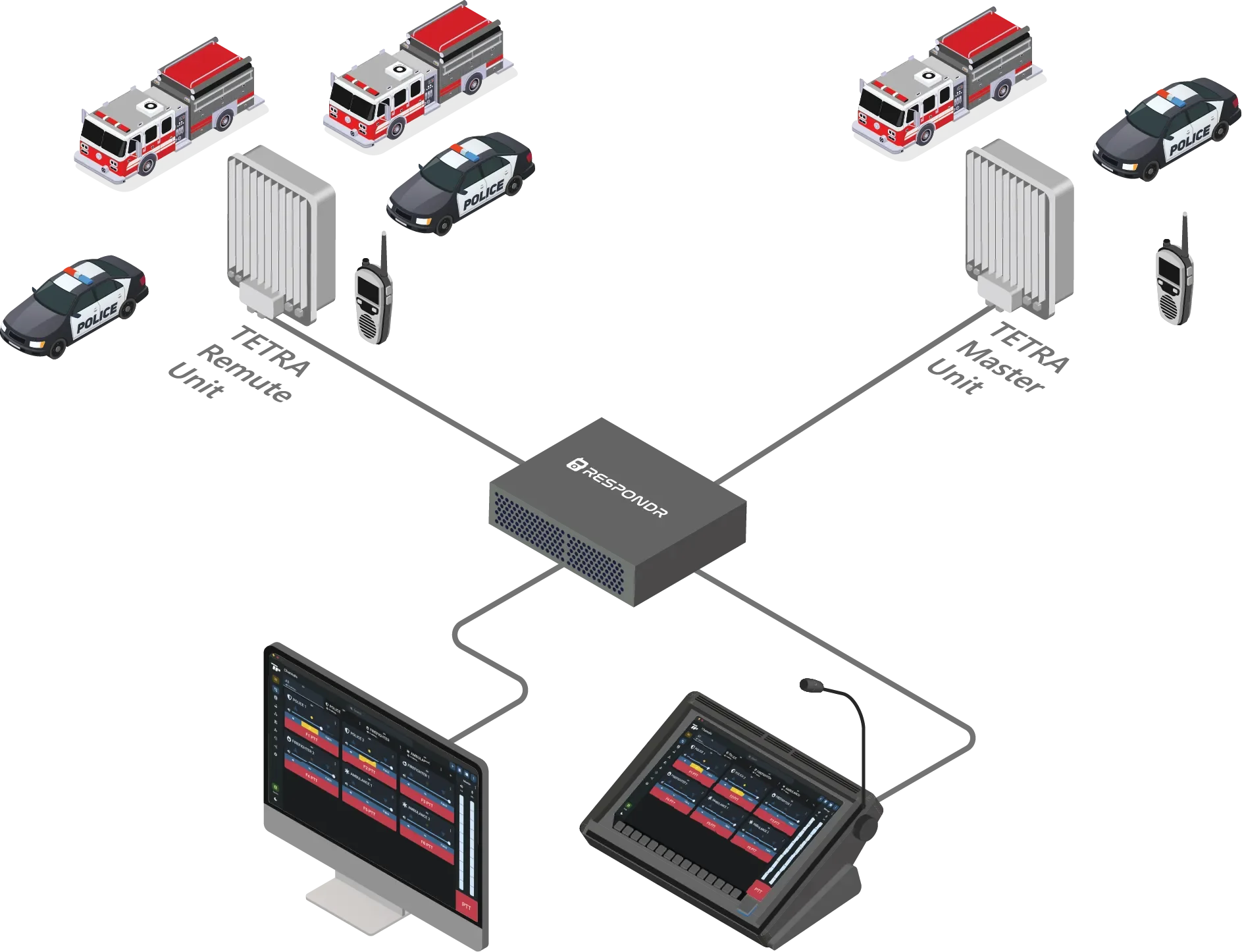
- Channel patching — bridge analog, DMR and TETRA traffic into one conversation
- Broadcasting — one message across all selected channels
- Voice recorder — every transmission archived with time, position and events
- Radio rooms — channels, users and gateways grouped per site or operation
Enterprise integration covers OIDC single sign-on, multi-factor authentication, role-based permissions down to the single channel, and configurable retention policies.
Key benefits of modern PTT systems
Organizations adopting IP-based PTT see benefits across operational, financial and strategic dimensions.
Operational excellence
- Instant communication — no ringing phones or voicemail delays; entire teams connect in moments
- Real-time supervision — live positions, presence indicators and status updates
- Ease of use — as simple as pressing a button, hands-free options for people on the move
Economic benefits
- Lower infrastructure costs — no repeaters or antennas to build, no radio-frequency licensing fees
- Devices you already own — existing smartphones and tablets become professional PTT terminals
- Operational savings — faster communications reduce downtime, and simple interfaces cut training time
Strategic value
- Better coordination — faster responses and more complex operations under control
- Risk reduction — encrypted communications, automatic recording and redundant systems
- Future-proof investment — software that updates continuously without replacing hardware
Applications and use cases by industry
Modern PTT serves industries with very different communication requirements.
Public safety and emergency services
First responders need reliable communications during emergencies: unified control rooms linking police, fire and medical services; automatic switching between cellular and Wi-Fi; encrypted recording with complete traceability; and dynamic channel linking across operational zones.
Transportation and logistics
Transport operations require constant coordination across wide areas: hands-free PTT keeps drivers focused on the road, control rooms follow live positions, and automatic recording supports documentation requirements.
Manufacturing and industrial operations
Complex facilities need reliable communications in harsh environments: clear audio with the right accessories in noisy areas, rugged PoC devices for the plant floor, instant connections between technicians and experts, and one-button emergency alerts.
Retail and hospitality
Customer-facing businesses need discreet, efficient team communications: instant connections between floor staff and management, dedicated channels for security teams, and multi-location coordination for regional managers.
Healthcare and medical facilities
Hospitals need secure communications for daily operations: instant activation of response teams, smooth coordination between departments, dedicated channels for security and patient transport.
PTT vs traditional communication methods
How PoC compares to the alternatives organizations typically weigh.
PoC vs phone calls
| Feature | Push-to-Talk | Phone calls |
|---|---|---|
| Connection speed | Instant — press and speak | Seconds of dialing and ringing |
| Group communication | Whole channels at once | Complex conference setups |
| Hands-free operation | Built-in support | Limited options |
| Documentation | Automatic recording | Not recorded |
PoC vs text messages
| Aspect | Push-to-Talk | Text/SMS |
|---|---|---|
| Speed | Real-time voice | Typing delays |
| Clarity | Tone and urgency carry | Risk of misunderstanding |
| Documentation | Automatic recording | Manual archiving |
| Multitasking | Hands-free capable | Requires eyes and hands |
PoC vs two-way radios
| Comparison | Modern PTT (Respondr) | Traditional radios |
|---|---|---|
| Coverage area | Wherever there is IP connectivity | Limited range |
| Audio | Clear digital audio | Static and interference |
| Channel capacity | Unlimited | Fixed channels |
| Features | Voice, GPS, messaging, recording | Voice only |
| Maintenance | Software updates | Hardware repairs |
The two worlds are not mutually exclusive: Respondr's radio gateways bridge existing VHF, DMR and TETRA networks with PoC, so both sides talk in the same channels.
Security and compliance
In an era of rising cyber threats and regulatory requirements, mission-critical communications need enterprise-grade security.
Encryption standards
- TLS 1.3 for transport security, with forward secrecy by design
- AES-256 encryption for stored data
- Token-based, certificate-backed authentication
Access control
- Multi-factor authentication (TOTP)
- OIDC single sign-on integration
- Role-based permissions down to the single channel
- Account lockout against brute-force attempts
Data governance
- Configurable retention policies and deletion schedules
- Audit-trail maintenance
- GDPR-aligned handling of personal data
Device management
- MDM auto-configuration of server, user and token settings
- Zero-touch enrollment on supported rugged devices
The future of Push-to-Talk technology
Where the industry is heading:
- 5G integration — lower latency, network slicing and edge computing promise even better real-time performance
- Unified communications — PTT converging with video, messaging and presence in single platforms
- IoT convergence — alerts from connected sensors feeding directly into operational channels
- Cloud-native architectures — elastic scaling and continuous updates without service interruptions
Conclusion
Push-to-Talk technology has evolved from simple radio transceivers into sophisticated communication platforms. Respondr combines the reliability people expect from radio with the flexibility of IP — one ecosystem covering the field app, the dispatch console and the gateways that keep existing radio networks in the conversation.
Whether you're coordinating emergency operations, managing a vehicle fleet or organizing terminal teams, effective instant communication is no longer a luxury — it's a necessity.